History
The castle of the Chapter of Warmia Bishopric is situated in the historic region called Warmia, which got its name from the pagan tribe. Its construction began in the 14th c. Simultaneously with the castle the town was built. The bishopric of Warmia, being a part of the State of the Teutonic Knights had to fight in the Polish-Teutonic war of 1409-1411 at the Teutonic side. After the defeat of the Teutonic Knights in the battle of Grunwald on July 15, 1410, Warmia swore allegiance to the Polish king. During the next war, in 1414, Polish troops captured the castle and city.
During the Thirteen Years War (1454-1466), the castle was taken over by the rebels opposing the authority of the Teutonic Order. Soon however, mercenaries led by Georg von Schlieben captured the fortress by deception. After conclusion of the Peace of Toruń (1466), Warmia was attached to the Kingdom of Poland. In 1520, during another war, units of Teutonic Knights failed to occupy the town and the castle.
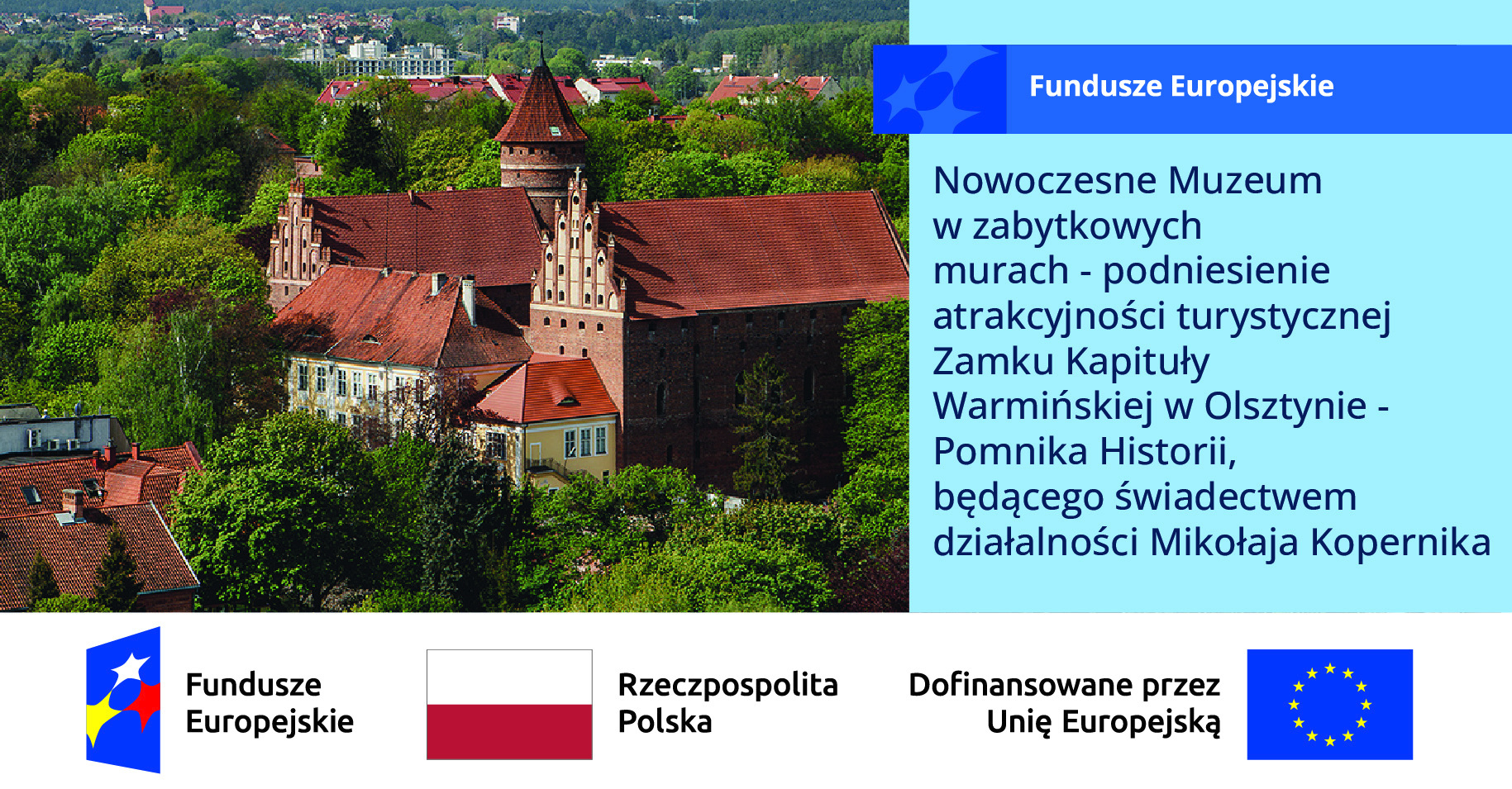
At that time, Nicolaus Copernicus was living in the castle (1516-1521) acting the administrator for the Chapter of Warmia Bishopric. Here, in Olsztyn, he began writing his famous work De Revolutionibus… The astronomical board in the castle gallery is the only astronomical instrument of the astronomer. It served observation of the apparent movement of the Sun and determination of the moment of the spring equinox (March 21). Copernicus was also involved in settlement of peasants on lands abandoned by the former users and he wrote the economic treaty concerning the “good” currency.
During the 18th century the baroque building was added to the gothic castle. At the same time dike connecting the fortress with the town was constructed.
Following the first partition of Poland (by the three bordering kingdoms: Russia, Prussia and Austria in 1772), Warmia was annexed by Prussia. During the World War II, the castle was not damaged and after 1945, when the territory was given to Poland, the Polish authorities converted the castle into a museum.
Architectural details
The stronghold in Olsztyn was established in place that was defensive naturally, but where there was no earlier settlement. The castle was built on a hill in the band of the Łyna River.
The north wing was built first with two levels of cellars, the first along the entire length of it and the second just under a half of that length. It was constructed as the seat of the administrative authorities. During the second stage of construction the courtyard was surrounded by walls and the tower, initially just twelve meters in height built, was built. When at the end of the 15th c. the development of firearms came, the curtain walls from the Łyna River side and the tower were made higher and the tower got its cylindrical section.
The economic wing was constructed as the south wing during the first half of the 15th c. Its defensive wooden gallery preserved until the present is unique in Poland.
The principal castle body was surrounded by the additional belt of walls, which were consolidated with urban fortifications. The tourist visit the residential hall of the administrator, the refectory and the crystal vaulting covered castle chapel as well as the granary floor of the north wing. During the summer season (June-September) it is possible to visit the castle tower.
Recommended further Reading
Andrzej Rzempołuch, Zamek kapituły warmińskiej w Olsztynie, Muzeum Warmii i Mazur, Olsztyn, 2009.
Małgorzata Jackiewicz-Garniec, Mirosław Garniec, Zamki państwa krzyżackiego w dawnych Prusach, Studio Arta, Olsztyn, 2006.
Information on services
Open: throughout the year
Guided Tours: on order
Museum shop: yes
Cafe/restaurant: yes
Internet: [www.muzeum.olsztyn.pl]
Contact: +48 89 527 95 96
Address: Muzeum Warmii i Mazur
ul. Zamkowa 2
10-074 Olsztyn